|
An Exploratory Study of the Impact
of Cultural Intelligence on Conflict
Management Styles: Evidence from Jordan

Khaled Tuguz
Rawan Abu Samra
Ibrahem Almallah
Department of Business Administration,
King Talal Faculty of Business and
Technology,
Princess Sumaya University for Technology,
Amman, Jordan
Abstract
The
purpose of this study is to determine
the impact of Cultural Intelligence
on conflict management styles in Jordan.
To address this topic, previous literature
was reviewed on Cultural Intelligence
and conflict-management styles to
find a possible link. Using this information,
a survey was constructed and distributed
among individuals of the Jordanian
society. Data obtained from the survey
was then analyzed using the SPSS software.
Results helped in determining which
Cultural Intelligence components possess
the greatest influence on conflict-management
styles among Jordanians. The study
concludes with a clearer picture of
the relationship between Cultural
Intelligence and conflict management.
This research contributes to the existing
literature studying both culture and
conflict by emphasizing the impact
of understanding culture on the effectiveness
of cross-cultural interactions.
Key words: Cultural Intelligence,
Conflict, Conflict Management, Conflict-Management
Styles, Jordan.
Introduction
Since the beginning of globalization,
the world has experienced disruptive
changes. People from different cultures
are now more interconnected due to
the advancements in telecommunication
and technology. Globalization has
expanded cultural borders and connected
the world in terms of time, space,
economies, organizations, and industries
(Earley et al., 2006). As a result,
there is an increasing need for developing
a better cross-cultural understanding
of different groups and for continually
improving intercultural-communication
skills to adapt to the requirements
of today's world (Earley et al., 2004).
Globalization is one of the main reasons
that prompt organizations to ask their
employees to work in multinational
environments and to travel from country
to country to accomplish organizational
goals (Earley & Peterson, 2004),
thereby making the workforce in most
countries more diverse and heterogeneous.
To obtain a clearer idea of how globalization
has affected cross-culture interactions
and increased conflict issues, the
most suitable definition of globalization
for this paper is as follows: globalization
is "a large scale interactive
social process in which people increasingly
interrelates, communicates, and works
in an increasingly culturally diverse
workplace both within and outside
the organization" (Earley et
al., 2006, p. 1). According to research
by previous scholars, this ease of
communication and its increased availability,
which is a result of globalization,
can generate more tension between
people from diverse cultures, producing
uncertainty and confusion among co-workers
(Akbulut, 2014; Kumar & Rajasekar,
2014).
Due to the different attitudes and
beliefs adopted by diverse cultures,
conflicts and disagreements are definite
results. Conflict is here defined
as the process in which people disagree
over significant issues, thereby creating
friction between parties (Rahim, 1997),
and this friction is often due to
differences that exist among individuals.
Managing conflict effectively among
different individuals with diverse
cultural backgrounds is one of the
main challenges faced by people, organizations,
and society. Consequently, managing
conflict is an imperative for ensuring
a healthy workplace that enhances
personal and organizational growth
(Forté, 1996).
It became crucial for organizations
and individuals to understand how
different cultures can influence and
affect the negotiations carried out
in conflict situations. While negotiating
conflict situations effectively across
different cultures has become a critical
skill for individuals, it has also
become an essential aspect of many
inter-organizational relationships
in the following areas: strategic
alliances, joint ventures, mergers
and acquisitions, licensing and distribution
agreements, and sales of products
and services (Adler, 2002). As a result,
people who understand how culture
influences conflict situations will
have a competitive advantage in today's
global marketplace (Gelfand &
Christakopoulou, 1999).
According to Imai in 2007, the culture
and conflict literature reveals little
about the characteristics that are
needed by the negotiators to achieve
optimal agreements in intercultural
situations. To remedy this deficit,
this research investigates the topic
of Cultural Intelligence (CQ), which
is defined as the individual's capability
to adapt effectively to situations
of cultural diversity (Earley and
Ang, 2003) and also examines its effect
on the conflict-management styles
used in Jordan while handling conflict
situations.
The reason for focusing on Cultural
Intelligence rather than other forms
of intelligence such as Social Intelligence
and Emotional Intelligence is because
Cultural Intelligence deals with individual's
skill levels in the face of cultural
barriers. This research seeks to examine
the impact of Cultural Intelligence
on conflict-management styles and
to ascertain whether it is a useful
predictor for choosing a particular
conflict-management style.
This research is designed to assess
quantitatively the Cultural Intelligence
variables and link them to the conflict-management
styles using Jordan as a context for
analysis. Hence, the data is based
on 133 participants' responses to
basic demographic questions (age,
nationality, and level of education)
and on the results of a five-point
Likert scale instruments for CQ and
conflict-management styles.
Literature Review
This section addresses the previous
literature about cultural intelligence
and conflict management, then the
next section will present a theoretical
framework developed by bridging the
two body of literatures.
Cultural Intelligence (CQ)
Since globalization took over the
modern business world, organizations
began focusing on the cultural side
of their environments. To ensure worldwide
competency, the workplace turned from
having a predominantly local or domestic
culture into one with a high diversity
of cultures in one place. Thomas Larsson
(2001) defined globalization as: "the
process of world shrinkage, of distance
getting shorter, things moving closer.
It pertains to increasing ease with
which somebody on one side of the
world can interact, to mutual benefit,
with somebody on the other side of
the world" (p. 8).
The effects of globalization have
spread through communities and cultures.
This context highlights the variety
of modern viewpoints in which conflict
may occur (Al-Rodhan & Stoudmann,
2006). Consequently, globalization
significantly impacts culture; for
example, Japanese culture is well
known for being strict with respect
to time, whereas Arabic culture commonly
regards timeliness as fairly flexible.
It will not be acceptable to a Japanese
manager if an Arabic employee arrives
10 minutes late, but this is perfectly
acceptable in the Arabic culture.
Globalization seeks to identify these
differences in various cultures to
increase familiarity between cultures.
These issues have resulted in a new
concept of generalizing one commonly
known culture between employees in
the same organization-a phenomenon
called Organizational Culture. This
culture gives the organization its
identity as cross-cultural organization.
According to research on cross-cultural
competency, the construct of cultural
intelligence has been described by
Gelfand, Imai, and Fehr (2008) as
the "new kid on the scientific
block" (p. 376). The term Cultural
Intelligence was defined for the first
time in 2003 as a multidimensional
construct that encompasses an individual's
capability to function and manage
effectively in cultural diverse settings
(Earley & Ang, 2003). This is
consistent with Schmidt's and Hunter's
(2000) definition of general intelligence
(IQ) as "the ability to grasp
and reason correctly with abstractions
(concepts) and solve problems,"
(p. 3) which has yielded several types
of intelligence that focus on specific
content domains, such as Social Intelligence,
Emotional Intelligence (EQ), and Practical
Intelligence (NG, Van Dyne, and Ang,
2012).
After 2003, Earley revised his prior
definition of general intelligence
to the following: an outsider's seemingly
natural ability to interpret someone's
unfamiliar and ambiguous gestures
the way that person's compatriots
would (Earley & Mosakowski, 2004).
Also in 2004, Thomas and Inkson defined
CQ as "the multifaceted competency
consisting of cultural knowledge,
the practice of mindfulness, and the
repertoire of behavioral skills"
(pp. 182-183). Peterson (2004), in
contrast, focused on the values and
attitudes side exposed to others with
the following definition of general
intelligence: "the ability to
engage in a set of behaviors that
uses skills (i.e. language or interpersonal
skills) and quantities (e.g. tolerance
for ambiguity, flexibility) that are
tuned appropriately to the culture-based
values and attitudes of the people
with whom one interacts" (p.
106). On the other hand, Thomas (2006)
defined general intelligence as the
capability that allows individuals
to understand and act appropriately
across a wide range of cultures.
According to Earley and Ang (2003),
the level of interpersonal skills
that employees possess within a culture
is independent from the level of interpersonal
skills that those employees possess
across cultures. That is, even though
concepts such as Emotional Intelligence
and Cognitive Ability may assist individuals
in understanding certain types of
information, this does not mean that
this information will help them in
social interactions, especially in
other cultures. In the end, just because
an individual has a high level of
interpersonal skills in his or her
own culture, he or she will not necessarily
adapt to people in the same way and
with ease if he or she were exposed
to a new culture. At the same time,
an individual with a low level of
interpersonal skills may have no problem
adjusting easily and quickly to new
cultural contexts.
In response to this need for understanding
individual differences in cultural
adaptation, Earley and Ang (2003)
conceptualized CQ as a multifaceted
characteristic consisting of the following
elements: Metacognitive CQ, Cognitive
CQ, Motivational CQ, and Behavioral
CQ. Metacognitive CQ refers to the
conscious awareness which an individual
has regarding cultural interactions,
as well as the ability to strategize
when crossing cultures and to carefully
ascertain personal thoughts and the
thoughts of others. Cognitive CQ reflects
the knowledge of a group's values,
beliefs, and norms; cognitive CQ also
addresses the knowledge dimension
of CQ, referring to the level of understanding
of culture and its role in determining
the style of doing business and interacting
with others across different cultures.
Motivational CQ reflects the capability
to direct energy toward learning about
cultural differences. It also refers
to the level of interest, drive, and
energy invested in cross-cultural
adaptations. Motivational CQ involves
intrinsic motivation, which is the
degree to which a person derives enjoyment
from culturally diverse situations;
extrinsic motivation, which prioritizes
the tangible benefits gained from
culturally diverse experiences; and
self-efficacy, which is the confidence
that one will be effective in cross-cultural
encounters. Finally, Behavioral CQ
reflects the ability to choose appropriate
verbal and physical actions when interacting
with people of different cultures.
In essence, behavioral CQ refers to
the ability to act appropriately in
the midst of cross-cultural issues,
indicating whether a person can accomplish
goals effectively in these issues.
These concepts were conceived by Earley
and Ang (2003) and were further developed
by Van Dyne, Ang, and Koh 2008 and
Van Dyne, Ang, and Livermore in 2010.
Conflict Management
Conflict is a common facet in the
daily lives of people, and it is generally
considered inevitable in organizations.
Studies indicate that managers spend
more than twenty percent of their
time dealing with conflict (Pondy,
1992; Pulhamus, 1991; Thomas &
Schmidt, 1976). Conflict can be the
result of strong divergent needs between
two or more parties (individuals,
groups, organizations, etc.), or it
may occur from misunderstandings and
misperceptions.
Conflict arises in various situations
either when both parties are working
toward achieving the same goal, or
when working toward different outcomes.
Conflict is often dynamic, escalating
and de-escalating according to the
situation.
The current literature does not include
a single or absolute definition of
conflict. According to general consensus,
conflict may be defined as an "interactive
process manifested in compatibility,
disagreement or dissonance within
or between social entities (i.e.,
individuals, group, organization,
etc.) which create organizational
change" (Rahim, 2002, p. 207).
Conflict may also be defined as "sharp
disagreement or opposition, as of
interests, ideas, etc.," and
it may include the "perceived
divergence of interest or a belief
that the parties' current aspirations
cannot be achieved simultaneously"
(Pruitt & Rubin, 1986, p. 4).
Researchers generally categorize and
contextualize the broad concept of
conflict by classifying it in four
different levels. This is considered
a commonly accepted categorization
and was introduced by Lewicki, Saunders,
Barry, and Minton in 2003. The levels
of conflict classification are as
follows: intrapersonal, interpersonal,
intragroup, and intergroup.
Intrapersonal conflict occurs within
an individual, taking place in his
or her mind. This is more a form of
psychological conflict, as the main
source of conflict is emotions, thoughts,
values, perceptions, and drives that
are in disagreement with each other.
An example of such conflict is when
a person is experiencing anxiety or
pressure from choosing between two
alternatives.
The second type of conflict is interpersonal,
which can be defined as "a form
of intense interpersonal dissonance
(that is, tension or antagonism) between
two or more interdependent parties
based on their incompatible goals,
needs, desires, values, beliefs, and/or
attitudes" (Ting-Toomey, 1985,
p.72). According to this definition,
this particular form of conflict involves
two or more parties.
Intragroup conflict is the third type
of conflict, arising between members
of the same group. An example of intragroup
conflict is one which occurs between
family members. This type of conflict
will have an evident effect on the
group's ability to be efficient and
effective in decision making, productivity,
resolution, and achieving group goals.
The fourth and final classification
is intergroup conflict, occurring
between different groups. An example
of this form of conflict is a feud
between organizations. This type of
conflict is often complicated, as
there are a large number of people
involved and countless ways of interacting
with each other.
Multiple scholars suggest that conflict,
and specifically organizational conflict,
has both functional and dysfunctional
outcomes (Jehn, 1995; Mirtoff, 1998;
Pelled, Eisenhardt, & Xin 1999).
In the past, scholars and individuals
believed that conflict is a negative
and destructive force that should
be avoided at all costs (Nicotera,
1993). Deutsch and others (1973) elaborated
that this negative image of the conflict
situation is based on many elements;
for example, conflicts are usually
emotionally charged, and this can
overwhelm clear thinking. In addition,
misperception and biases are often
formed because people view a situation
according to their own perspectives,
interpreting the situation in stereotypical
and biased ways. Furthermore, individuals
can become competitive and only perceive
situations as "win-lose"
scenarios. When individuals become
more committed to their own position,
they are often less interested in
productive communication, which can
make issues more blurred and less
defined. All of these will cause an
escalation of conflict, since differences
are magnified and similarities are
neglected (Deutsch, 1973).
However, conflict cannot only be perceived
as dysfunctional, but it should also
be perceived as an opportunity for
growth that possesses many productive
aspects (Coser, 1956; Deutsch, 1973).
Consequently, conflict itself is not
simply productive or destructive:
it is actually both. Once conflict
was no longer perceived as dysfunctional,
but instead as a healthy process that
needs to be contained and managed
properly through negotiations, structural
adaptation, and other forms of intervention
(Kolb & Putnam, 1992), the concept
of conflict management emerged.
Conflict management involves "designing
effective macro level strategies to
minimize the dysfunctions of conflict
and enhancing the constructive functions
of conflict in order to enhance learning
and effectiveness in an organization"
(Rahim, 2002, p. 208). This definition
illustrates that the main objective
of conflict management is not to eliminate
conflict, but to find different ways
to manage it properly through controlling
the dysfunctional elements of the
conflict while facilitating its productive
aspects (Rahim, 2002). Conflict management
also refers to the styles used by
either or both parties to cope with
a conflict (Keenan et al., 1998).
As a result, an individual's response
to a conflict situation with different
styles and strategies may limit or
enable the success of dealing with
the situation (Rahim, 2011).
A number of frameworks for handling
conflict have been suggested and constructed
by previous scholars to measure the
tendency of using these approaches
by each party (Filley, 1975; Hall,
1969; Rahim, 1992; Thomas, 1992; Thomas
& Kilmann 1974). In this paper,
the framework used to discuss conflict-management
styles is one proposed by Dean Pruitt,
Jeffery Rubin, and S.H. Kim (1994),
based on research by Rahim and Bonoma
(1979). This framework differentiates
the styles of handling conflict into
two distinct dimensions: concern for
self and concern for others.
The concept of concern for self explains
the degree to which a person tries
to fulfill and satisfy his or her
goals. The stronger the individual's
concern for self, the more likely
he or she will be to pursue strategies
that focus on personal concern for
outcomes; the weaker a person's concern
for self, the more likely he or she
will be to pursue strategies that
will overlook personal interest (Rahim,
2002). Concern for others explains
the degree to which individuals try
to satisfy the goals and needs of
the other party. Therefore, the stronger
a person's concern for others, the
more likely he or she is to engage
in encouraging and helping the other
party to achieve his or her outcome;
the weaker the concern for others,
the more likely an individual is to
overlook consequences related to the
other party (Rahim, 2002).
Combining these two dimensions is
represented in the five different
styles of handling conflict: contending,
yielding, inaction, problem solving,
and compromising. The first style,
contending, is also called dominating
or competing. This perspective involves
high concern for self and low concern
for others. This style follows a win-lose
approach where high levels of competition
are found. There is no cooperation
between parties, and the main aim
is to win at any cost to satisfy personal
concern, regardless of the concerns
of others (Rahim, 2002). Contending
may also include standing up for one's
rights and/or defending a position
which the party believes to be correct
(Rahim, 2011). Individuals who follow
this approach try to persuade the
other party to yield (Pruitt &
Rubin, 1986). This strategy is appropriate
when there is a need for a speedy
decision and can be helpful in overcoming
assertive subordinates. It is also
beneficial when an issue is generally
trivial and only important to the
party, or when subordinates lack the
expertise needed to make appropriate
technical decisions (Rahim, 2011).
Situations in which contending is
inappropriate occur when the issue
is complex and not important to the
individual, when both parties are
equally powerful, when speedy decisions
are not needed, or when subordinates
possess a high degree of competence
(Rahim, 2011).
The second style of handling conflict
is yielding, which is also known as
accommodating or obliging. This style
occurs when there is low concern for
self and high concern for others (Rahim,
2002). In some cases conflict resolution
may be at the individual's own expense
in the hope of obtaining future benefits
from the other party (that is, self-sacrifice
to gain something in the future).
This style mainly attempts to play
down the differences and emphasize
the commonalities between the parties
to satisfy their concerns (Rahim,
2011). This is considered an advantage
in situations where the individual
believes he or she may be wrong, when
an issue is more important to the
other party, when the individual is
acting from a position of weakness,
or when the individual thinks that
preserving the relationship is more
important (Rahim, 2011). However,
yielding is inappropriate in cases
where the issue is highly important
to the individual, when the individual
thinks he or she is right, or when
the other party acting unethically
or wrongly (Rahim, 2011).
The third style of handling conflict
is "inaction," also called
avoiding. This style involves low
concern for self and low concern for
others (Rahim, 2002). Avoiding generally
occurs when the individual shows little
interest in attaining both personal
concerns and concerns for others,
and subsequently decides to withdraw
from the situation either by being
silent or by doing nothing (Rahim,
2011). This style is appropriate when
an issue is trivial, when a "cooling
off" period is needed, or when
potentially negative consequences
of confronting the other party outweighs
the advantages of resolution (Rahim,
2011).
The fourth style of handling conflict
situations is problem solving, also
known as collaborating or integrating.
Individuals who pursue this style
show high concern for self and high
concern for others. As a result, cooperation
and collaboration is needed to reach
acceptable solutions that will satisfy
both parties (otherwise known as a
"win-win" approach) (Rahim,
2002). Openness and sharing of information
are needed to ensure an effective
result. Problem solving is useful
in complex situations, when there
is adequate time for problem solving,
or when one party cannot solve the
problem alone. To ensure successful
implementation, commitment is needed
from both parties (Rahim, 2011). Problem
solving is considered inappropriate
when the problem is simple, when immediate
decisions are required, when other
parties are unconcerned about the
outcome, or when parties do not possess
problem solving skills.
Compromising is the fifth conflict-management
style and is the intersection between
the two dimensions. It represents
a moderate effort in pursuing one's
personal interests and a moderate
effort in helping the other party
achieve his or her outcomes (Rahim,
2002). That is, both parties give
up something in order to obtain an
acceptable decision. Compromising
is needed when the goals of both parties
are mutually exclusive, when both
parties are powerful, when agreements
cannot be reached, when dominating
or integrating styles are not successful,
or when a temporary solution is needed
for a complex problem (Rahim, 2011).
However, compromising is inappropriate
when one party is more powerful than
the other, or when the problem is
so complex that it needs a problem
solving approach (Rahim, 2011).
Some behavioral researchers suggest
that the problem-solving style is
the most appropriate for managing
conflict (e.g. Blake & Mouton,
1964; Burke, 1970; Likert & Likert,
1976). However, other researchers
maintain that for conflict to be managed
properly and functionally, one style
may be more appropriate than another,
depending on the situation (Hart,
1991; Rahim & Bonoma, 1979; Thomas,
1977). Consequently, understanding
these different styles of conflict-managing
behavior will enable the individual
to select the most appropriate style
when facing conflict by giving the
individual the opportunity to enhance
the communication process between
the different parties involved (Rahim,
2002).
Theoretical framework
Research by Rahim suggests that Emotional
Intelligence is closely related to
conflict-management strategies (2002),
suggesting that the five dimensions
of EQ (Self-Awareness, Self-Regulation,
Motivation, Empathy, and Social Skills)
are positively correlated. These dimensions
also involve personal motivation,
dividing the conflict-management strategies
into two dimensions: problem-solving
strategy and bargaining strategy.
Finally, research also suggests that
motivation is positively related to
a problem-solving strategy (integrating-avoiding)
and is negatively associated with
a bargaining strategy (dominating-obliging),
according to Rahim (2002). Consequently,
motivation serves as the main dimension
of EQ used to measure the relationship.
Motivation functions as an EQ dimension,
and it is therefore also a component
of CQ. When motivation is compared
in terms of CQ and as a dimension
of EQ, they are demonstrably similar.
Although CQ is more specific in terms
of defining the goal, a link exists
between Cultural Intelligence and
Emotional Intelligence in which CQ
continues where EQ concludes (Earley
& Mosakowski, 2004).
Several studies have related culture
to conflict-style preference (Kim-Jo
et al., 2010). A first stream of research
examines how individuals exposed to
more than one culture (e.g., bicultural
persons) handle interpersonal conflict.
Other studies investigate one culture
and probe its conflict-management
style preference. Also common in these
studies is the a priori categorization
of cultures as individualist or collectivist
based on Hofstede's study in 1980.
For example, individuals from the
U.S. and Australia represent individualist
cultures, while cultures from China,
Taiwan, Korea, Japan, and Hong Kong
are collectivist. However, these studies
examine the conflict-style preference
of each culture, but do not address
the conflict-style preference of an
individual and his or her ability
to adapt culturally.
Cultural intelligence is an important
predictor of affective as well as
performance-related outcomes in culturally
diverse situations. In addition, empirical
research is an important predictor
of affective as well as performance-related
outcomes in culturally diverse situations,
based on what empirical research shows.
For example, research by Ang and colleagues
(2007) found that the ability to make
accurate cultural judgments and to
report greater interactional adjustments
describes individuals with higher
CQ than those with lower CQ. This
aptitude extends beyond cognitive
ability, emotional intelligence, personality,
and international experience. The
same authors found in organizational
contexts that international managers
who performed better on an intercultural
business task, controlling for cognitive
ability and international experience,
are those with higher CQ.
Furthermore, in a sample of foreign
professionals, Ang and colleagues
(2007) also found that CQ is a better
predictor of higher job performance
than international experience, as
rated by supervisors. Another study
by Templer, Tay, and Chandrasekar
(2006) concluded that greater cross-cultural
adjustment was experienced by expatriates
with higher CQ than those with lower
CQ, taking into account the realistic
previews of the job and living conditions
expatriates received, as well as time
spent in the host country and prior
international experience. More recent
research has found that that CQ is
negatively related to burnout among
business travelers working in multinational
corporations (Tay, Westman, &
Chia, 2008) and is positively related
to how quickly employees are integrated
into multicultural work teams (Flaherty,
2008).
Most recent empirical research studying
CQ in the domain of negotiation (Imai
& Gelfand, 2010) maintains that
individuals with higher CQ have greater
cooperative motives as well as higher
epistemic motivation than individuals
with lower CQ. The researchers stated
that dyads consisting of negotiators
with higher CQ will engage in more
effective sequences of integrative-information
behaviors than dyads of negotiators
with lower CQ. Being more cooperative
and maintaining higher CQ will allow
negotiators to adopt more-integrative
negotiation strategies. Negotiation
is a form of conflict management.
However, the literature has not covered
the study of CQ robustly in relation
to conflict management.
Although CQ has been studied in a
wide variety of contexts, a gap still
exists in the literature with regards
to studying its relation to conflict
management, even after the study by
Imai and Gelfand (2010). According
to Rahim (2011), each conflict-management
style has some characteristics implied
in each individual's mindset: if a
person has a selfish side, a high
concern for self and a low concern
for others, and ignores what others
want, then he or she will tend to
use the Dominating style over other
CM styles. On the other hand, if a
person is primarily focused on the
needs of others over self, has a mentality
of self-sacrificing for common good,
and prioritizes maintaining current
relationships (knowing that some of
these relationships will be lost if
the conflict continues), then the
person will tend to use the Obliging
CM style. When there is a lack of
interest in self, others, or even
in the whole issue, then the person
withdraws from the situation, resulting
in the Avoiding CM style. If an individual
is willing to help others, to share
information with them, and to maintain
a high concern for both self and others,
he or she is using the Integrating
CM style. Finally, the Compromising
CM style involves a moderate level
of effort to reach outcomes, moderate
concern, moderate interest, and a
moderate willingness to help others.
This style is used in the case where
someone is selfless to obtain something
else. According to Earley and Mosakowski
(2004), there are three main facets
of cultural intelligence (Cognitive
CQ, Physical CQ, and Emotional/Motivational
CQ). Each facet possesses distinctive
traits and characteristics that will
affect an individual's level of CQ,
which in turn will impact the decisions
made in conflict situations.
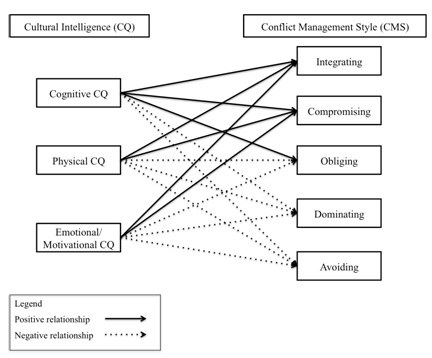
Based on these concepts, the main
purpose of this section is to develop
a theoretical framework that traces
the relationship between facets of
cultural intelligence facets and conflict-management
styles. Based on this objective, a
set of 15 suggested hypotheses have
been developed. These hypotheses are
divided into three groups according
to each CQ facet (five hypotheses
for each CQ facet).
The first CQ facet is Cognitive CQ,
which involves having knowledge of
other cultures. This requires knowing
what culture is, how it varies, and
how it affects behavior. Consequently,
Cognitive CQ allows an individual
to make predictable and more-accurate
decisions during an intercultural
interaction (Adler, 2002). An individual
with high cognitive CQ is more aware
of others' values and norms because
he or she is wants to invest time
and effort in forming an understanding
of the cultural surrounding to adapt
effectively in intercultural situations
and conflicts (Imai & Gelfand,
2010). Because of this, an individual
with a higher Cognitive CQ will have
a higher concern for others when dealing
with an intercultural conflict situation
to maintain social affiliation. With
this in mind, five different hypotheses
regarding high Cognitive CQ are established:
Hypothesis 1a: Individuals
with high Cognitive CQ will have a
positive relationship in choosing
integrating style.
Hypothesis 1b: Individuals
with high Cognitive CQ will have a
positive relationship in choosing
compromising style.
Hypothesis 1c: Individuals
with high Cognitive CQ will have a
positive relationship in choosing
obliging style.
Hypothesis 1d: Individuals
with high Cognitive CQ will have a
negative relationship in choosing
dominating style.
Hypothesis 1e: Individuals
with high Cognitive CQ will have a
negative relationship in choosing
avoiding style.
Turning next to Physical CQ, an
individual with higher Physical CQ
tend to control his or her external
factors that are perceived by others.
These factors-such as body language,
facial expressions, and tone-are controlled
in a way that reflects a person's
ability to adapt to different intercultural
situations. It may therefore be further
elaborated that this facet occupies
the body category laid out by Earley
and Mosakowski (2004). An individual
with high Physical CQ must mirror
the other party through convincible
actions and behavior. This is done
by showing others that he or she has
adopted their key habits, mannerisms,
and cultural gestures. With this in
mind, five different hypotheses regarding
high Physical CQ are developed:
Hypothesis 2a: Individuals
with high Physical CQ will have a
positive relationship in choosing
integrating style.
Hypothesis 2b: Individuals
with high Physical CQ will have a
positive relationship in choosing
compromising style.
Hypothesis 2c: Individuals
with high Physical CQ will have a
negative relationship in choosing
obliging style.
Hypothesis 2d: Individuals
with high Physical CQ will have a
negative relationship in choosing
dominating style.
Hypothesis 2e: Individuals
with high Physical CQ will have a
negative relationship in choosing
avoiding style.
Last but not least is the Emotional/Motivational
CQ facet. This is a critical component
of CQ because it drives an individual's
decisions and behaviors. Because emotions
and motives are intrinsic, an individual
with high Emotional/Motivational CQ
must be confident in his or her own
efficacy to understand people from
different cultures and to overcome
cultural obstacles. Those with high
levels of Emotional/Motivational CQ
can direct their attention toward
intercultural situations based on
their intrinsic interest in cultures
(Deci & Ryan, 1985) and their
confidence in intercultural effectiveness
(Bandura, 2002). High Emotional/Motivational
CQ can combine a rich understanding
of self and others and can allow the
individual to adapt to specific conflict-management
styles in cross-cultural situations.
Individuals who have high Emotional/Motivational
CQ can develop positive attitudes
and perceptions, which allow them
to engage in the constructive exchange
of information. They will listen and
will try to understand the perspective
of others. As a result, motivated
negotiators are more likely to uncover
possibilities for resolution and to
find integrative potential (Deutsch,
1973; Tjosvold, 1998). Based on this
understanding, five different hypotheses
regarding high Emotional/Motivational
CQ are developed:
Hypothesis 3a: Individuals
with high Emotional/Motivational CQ
will have a positive relationship
in choosing integrating style.
Hypothesis 3b: Individuals
with high Emotional/Motivational CQ
will have a positive relationship
in choosing compromising style.
Hypothesis 3c: Individuals
with high Emotional/Motivational CQ
will have a negative relationship
in choosing obliging style.
Hypothesis 3d: Individuals
with high Emotional/Motivational CQ
will have a negative relationship
in choosing dominating style.
Hypothesis 3e: Individuals
with high Emotional/Motivational CQ
will have a negative relationship
in choosing avoiding style.
Figure 1: Hypothesized
relationships between Cultural Intelligence
and Conflict Management Styles
In the next section of the paper,
the methods used will be presented.
Method
Subject Selection and Description
This research includes a total of
133 participants ranging in age from
18 to 64 years old. The sample mainly
consists of employees of NGOs and
UN Agencies dealing with different
cultural backgrounds in Jordan. The
sample consisted of 57 (42.9%) males
and 76 (57.1%) females. The majority
of the participants' nationalities
were Jordanian (83.4%); others were
part of nationalities from other Arab
countries (13.5%), and a few participants
had North American as well as Asian
nationalities. Regarding the participants'
levels of education, 94 (70.7%) participants
held a Bachelor's Degree, 21 (15.8%)
had finished college, 12 (9%) held
a Master's Degree, and the rest either
held a Ph.D. or only had completed
a high-school level of education.
Research Design and Instrumentation
This study was designed to assess
quantitatively the variables of Cultural
Intelligence and to relate them to
conflict-management styles in Jordan.
Consequently, data collection is based
on participants' responses to basic
demographic questions (age, nationality,
and level of education) and their
results on a 5-point Likert scale
for Cultural Intelligence and for
conflict-management styles.
Dependent Variables: Conflict-Management
Instrument
The conflict-management-styles instrument
was developed by Oetzel (1998) in
his study "The Effects of Self-Construals
and Ethnicity on Self-Reported Conflict
Styles," after it was originated
by Rahim's work in conflict management.
The instrument was made up of 28 questions
developed by Rahim's (1983) inventory
(ROCI-II) of measuring conflict styles,
followed by 10 more questions developed
by Ting-Toomey, Yee-Jung, Shapiro,
Garcia, Wright, and Oetzel to appraise
the ethnic and cultural background
effect. Its reliability in the original
article for each conflict-management
style ranged from 0.69 to 0.91 (Oetzel,
1998) (See Appendix 1). Each statement
in this instrument is also measured
using a 5-point Likert scale. Each
statement corresponds with one style
of conflict management, allowing each
style to have a specific number of
statements that measure it.
To control situational constraints,
two scenarios were developed. Participants
were asked to envision the scenario
and then to evaluate the statements
in the instrument accordingly. The
scenarios involved a CEO requesting
a task from a group of company employees
that included the participant; the
participant was then voted into a
group to accomplish this task, whether
his or her department group or an
unfamiliar group. The responsibilities
and rewards in each scenario were
either shared or individual. This
was designed to include two different
situational features in which the
participant would either be in a competitive
situation (out-group) or in a cooperative
situation (in-group). Each participant
randomly received either a competitive
or a cooperative scenario.
Independent Variables: Cultural
Intelligence Instrument
The Cultural Intelligence instrument
was proposed by Earley and Mosakowski
(2004) in their study on Cultural
Intelligence. This instrument consists
of twelve statements, divided into
three sets: Cognitive CQ, Physical
CQ, and Emotional/Motivational CQ.
Each set reflects a different facet
of CQ and is measured using a 5-point
Likert scale. These facets are calculated
by adding the scores of the statements
in the set and then dividing the sum
by the number of statements in the
set, resulting in an average of the
participant's CQ in that specific
facet. An average less than three
indicates the need for improvement,
while an average greater than 4.5
reflects CQ strength.
The reliability (Cronbach's alpha)
of the items measuring Cognitive CQ
was 0.384. Items measuring Physical
CQ had a Cronbach alpha of 0.562,
and items measuring Emotional/Motivational
CQ had a Cronbach alpha of 0.537.
These low values suggest that the
instrument is not reliable, which
is likely due to the low number of
items measuring each variable as well
as the low number of participants.
A higher number of participants would
likely make this study more reliable.
Furthermore, participants may have
misunderstood the survey questions
and provided incorrect answers, as
the instrument was originally designed
for western cultures.
Data-Collection Procedure
Online surveys were conducted in both
Arabic and English language. Data
collection occurred over nine days.
The surveys were distributed through
emails and participation was voluntary.
The responses were mainly collected
through snowball-sampling technique:
that is, participants who received
the survey passed it on to other respondents.
Data-Analysis Procedures
SPSS software was used to analyze
the collected data. The software package
SPSS Statistics was used for statistical
analysis. Reliability statistics were
conducted for each set of questions
to test each variable and to check
the reliability of the instrument.
Cronbach's alpha was calculated for
each variable or construct to test
the inter-correlations of items to
measure a single variable or construct.
When the items measuring the same
construct are highly correlated, the
questionnaire is considered reliable.
To analyze and to understand the sample,
an initial descriptive analysis is
conducted on the data. Afterwards,
multiple linear regressions are constructed
to test the relationships between
the variables being studied.
Results
This section discusses the results
obtained with data analysis. The collected
data was analyzed to understand its
implications on the research hypotheses.
The descriptive analysis was investigated
thoroughly to examine the sample population
and its characteristics. Further analysis
was performed through regression and
Pearson's correlation to assess the
hypothesis and to understand the relationships
between variables.
Sample Description and Frequencies
In this section, frequencies of the
sample's demographic characteristics,
such as gender, age, nationality,
level of education, and organization
are explained. As mentioned previously,
the number of participants was 133:
76 were females, and 57 were males.
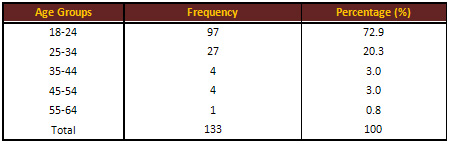
The majority of the participants were
between 18 and 24 years old. This
age range is congruent with modern
Jordanian society which is comprised
mostly of youth.
Table 1: The Frequencies and
Percentages of the Participants Gender

Table 2: The Frequencies and Percentages
of the Participants Age Groups
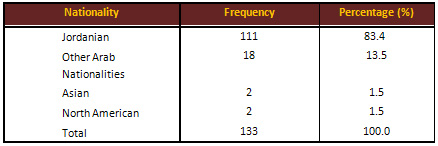
Because the study was conducted in
Jordan, most participants were of
Jordanian nationality (111 out of
133); the remaining 22 were of different
nationalities.
Table 3: The Frequencies and Percentages
of the Participants Nationalities
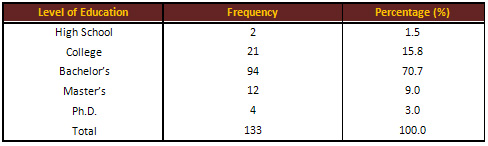
Regarding participants' level of
education, most participants (71%)
either had a bachelor's degree or
were enrolled in bachelor's-degree
programs; 16% of the population was
enrolled in college. The rest of the
participants had either attained higher
level of education or were in high-school.
These individuals mostly comprise
current and future employees. Ergo,
their involvement in the study was
important.
Table 4: The Frequencies and Percentages
of Participants Level of Education
Multiple Linear Regressions
To confirm the relationship between
the dependent and independent variables,
five multiple linear-regression analyses
were performed. In each regression
the conflict-management style served
as the dependent variable, and the
three facets of cultural intelligence
served as the independent variables.
The demographic variables were also
included as independent variables
in each regression to isolate other
variables and to obtain the best results
while testing the relationship. As
a result, in each regression each
variable showed a different p-value
and correlation to the dependent variable.
These relationships are illustrated
in detail in the following sub sections
and tables.
Integrating Style
Table 5: Integrating Conflict-Management
Style Model Summary

As shown in Table 5, for the integrating
style, R represents the variation
in the model, and the R square value
indicates that 17.5% of the variation
in integrating-style models can be
explained by the variability of CQ
facets and demographic factors.
Table 6: Coefficients of the Independent
Variables in the Integrating Style
Model
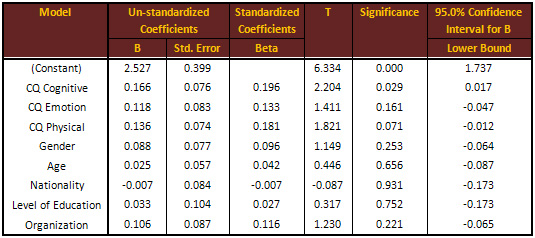
According to the results showed in
Table 6, there is a relationship between
the independent variables (focusing
only on Cognitive CQ, Physical CQ,
and Emotional CQ) and the integrating
style. Cognitive CQ has a coefficient
of 0.166, which indicates a positive
relationship, and a significance value
of 0.029, which means that this relationship
is significant because it is below
0.05. On the other hand, Physical
CQ has a coefficient of 0.136 and
significance value of 0.071, which
may be considered slightly significant
because the sample size was small
and the questions were minimal. Emotional
CQ has a coefficient of 0.118 and
significance value of 0.161 which
means that the relationship is not
significant.
Compromising Style
Table 7: The Compromising Conflict-Management
Style Model Summary

As shown in Table 7, for the compromising
style, the R-square value indicates
that 28.7% of the variation in the
compromising-style model can be explained
by the variability of CQ facets and
demographic variables.
Table 8: Coefficients of the Independent
Variables in the Compromising Style
Model
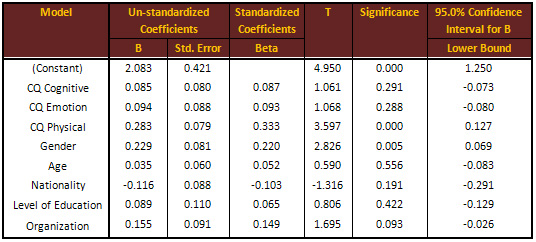
According to Table 8, there is a
relationship between the independent
variables (focusing only on Cognitive
CQ, Physical CQ, and Emotional CQ)
and the compromising style. Physical
CQ has a coefficient of 0.283, which
indicates a positive relationship,
and a significance value of 0.000,
which means this relationship is very
significant (<0.05). On the other
hand, Cognitive CQ has a coefficient
of 0.085 and Emotional CQ has a coefficient
of 0.094, but both have significance
values that are greater than 0.05
(0.291 and 0.288, respectively), meaning
that their relationships with this
style are not significant.
Obliging Style
Table 9: Obliging Conflict-Management
Style Model Summary

As shown in Table 9, for the obliging
style, the R-square value indicates
that 14.4% of the variation in the
obliging-style model can be explained
by the variability of CQ facets and
by demographic variables.
Table 10: Coefficients of the
Independent Variables in the Obliging
Style Model
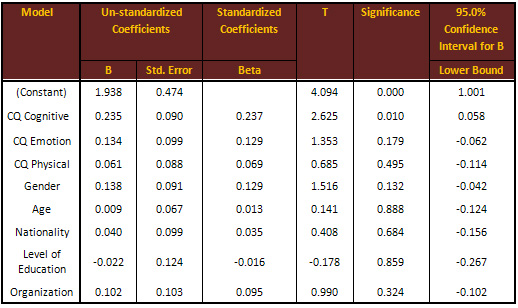
According to Table 10, there is
a relationship between the independent
variables (focusing only on Cognitive
CQ, Physical CQ, and Emotional CQ)
and the obliging style. Cognitive
CQ has a coefficient of 0.166, which
indicates a positive relationship,
and a significance value of 0.029,
which means that this relationship
is significant (<0.05). Physical
CQ has a coefficient of 0.136 and
Emotional CQ has a coefficient of
0.118, but the significance values
for both Physical and Emotional CQ
are greater than 0.05 (0.495 and 0.179,
respectively), indicating that their
relationships with the obliging style
are not significant.
Dominating style
Table 11: Dominating Conflict-Management
Style Model Summary

As shown in Table 11, for the dominating
style, the R-square value indicates
that 12.9% of the variation in dominating-style
model can be explained by the variability
of CQ facets and by demographic variables.
Table 12: Coefficients of the
Independent Variables in the Dominating
Style Model
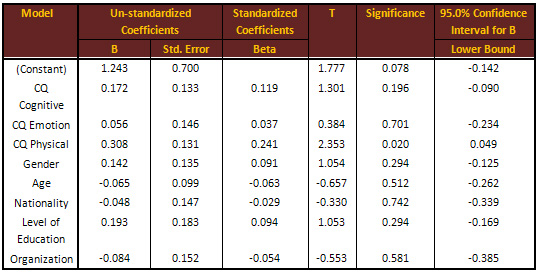
According to Table 12, there is
a relationship between the independent
variables (focusing only on Cognitive
CQ, Physical CQ, and Emotional CQ)
and the dominating style. Physical
CQ has a coefficient of 0.308, which
indicates a positive relationship,
and a significance value of 0.020,
which suggests this relationship is
very significant (<0.05). Cognitive
CQ has a coefficient of 0.172 and
significance value of 0.196, which
is not considered significant. Emotional
CQ has a coefficient of 0.056 and
a significance value of 0.701, which
is also considered not significant
in the case of the dominating style.
Avoiding Style
Table 13: Avoiding Conflict-Management
Style Model Summary

As shown in Table 13, for the avoiding
style, the R-square value indicates
that 21.4% of the variation in the
avoiding-style model can be explained
by the variability of CQ facets and
by demographic variables.
Table 14: Coefficients of the Independent
Variables in the Avoiding Style Model
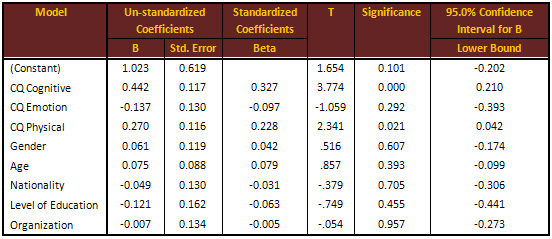
According to Table 14, there is
a relationship between the independent
variables (focusing only on Cognitive
CQ, Physical CQ, and Emotional CQ)
and the avoiding style. Cognitive
CQ has a coefficient of 0.442, which
indicates a positive relationship;
its significance value of 0.000 means
this relationship is very significant,
since it is below 0.05. Physical CQ
has a coefficient of 0.270 and significance
value of 0.021, which is also considered
significant. On the other hand, Emotional
CQ has a coefficient of -0.137, which
represents a negative relationship,
and a significance value of 0.292,
which is greater than 0.05 and therefore
not significant.
Discussion
The purpose of this study is to examine
whether a relationship between Cultural
Intelligence and Conflict Management
Styles exist or not. To do so the
Jordanian context was taken into consideration.
This was designed to contribute to
society by improving the effectiveness
of intercultural interactions in the
daily lives of the individuals. This
section will compare and elaborate
the hypotheses developed in the theoretical
framework with the results obtained
from the data collection, as shown
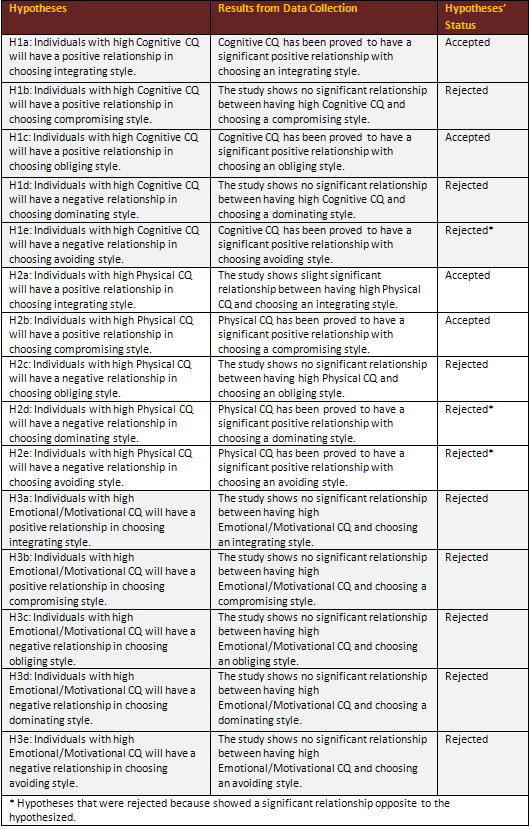
in following Table.
Table 15: Summary of the Hypothesis
and Actual Results Obtained
H1a: Individual with high Cognitive
CQ will have a positive relationship
in choosing integrating style.
Results indicate a significant positive
relationship between Cognitive CQ
and choosing integrating conflict-management
style, which supports the hypothesis
above. Cognitive CQ reflects the desire
to learn and absorb the norms, values,
and methods of other cultures when
approaching intercultural interactions
(Earley & Mosakowski, 2004). These
individuals are willing to know more
about the other party and develop
some kind of concern towards them,
comprehending and decoding the behavior
of others and of self (Thomas et al.,
2008). This idea relates to the integrating
conflict-management style, which involves
a high sense of concern for self and
for others: the individual is keen
on sharing information and knowledge
about himself or herself and others
(Rahim 2011).
H1c: Individuals with high
Cognitive CQ will have a positive
relationship in choosing obliging
style.
When an individual is willing to
understand the other party's culture
and how he or she thinks and behaves,
this person is showing concern for
others and is not concerned for self.
This supports Rahim's explanation
of the obliging style which involves
low concern for self and high concern
for others.
H2a: Individuals with high
Physical CQ will have a positive relationship
in choosing integrating style.
H2b: Individuals with high
Physical CQ will have a positive relationship
in choosing compromising style.
Results show that the significance
value of Physical CQ is 0.071, which
is slightly higher than 0.05. However,
this is likely due to the few questions
involved in the study and the low
number of participants. Therefore,
this hypothesis can be taken into
consideration.
Physical CQ represents the individual's
ability to tailor verbal and nonverbal
actions when interacting cross-culturally.
An individual with high Physical CQ
will know exactly when to use needed
words, phrases, and actions when facing
intercultural conflict (Thomas et
al., 2008). Therefore, when an individual
modifies his or her actions according
to cultural contexts, it may result
in different outcomes: for example,
an individual will try to achieve
optimal solutions by adapting to the
other party's culture and by showing
concern for others, while simultaneously
showing concern for self to satisfy
both parties. Consequently, high Physical
CQ is linked with Rahim's integrating
style of handling conflict (concern
for self and others).
H2d: Individuals with high Physical
CQ will have a negative relationship
in choosing dominating style.
Results suggest there is a significant
positive relationship between having
high Physical CQ and choosing dominating
conflict-management style, which opposes
the stated hypothesis. To elaborate
this point, Thomas and others (2008)
stated in their study entitled "Cultural
Intelligence Domain and Assessment"
that Physical CQ-also known as behavioral
CQ-is the nonverbal and verbal actions
that are taken by individuals in cross-cultural
interactions. This type of individual
will know when to adapt to another
culture and when not to do so (Thomas
et al., 2008), thereby indicating
that an individual with high physical
CQ can tailor his or her actions according
to certain cultural contexts with
varied outcomes. According to the
results obtained from the analyzed
data, individuals in Jordanian society
chose to adapt their actions by preferring
the dominant style of handling conflict,
which is associated with low concern
for others and high concern for self
(Rahim, 2011).
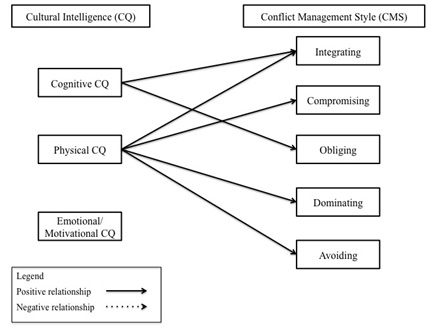
Figure 2: Significant Relationships
between Cultural Intelligence and
Conflict Management Styles
Conclusion
The purpose of the study was to find
the impact of Cultural Intelligence
on choosing conflict-management styles
by using existing literature as well
as by analyzing primary data collected
through an online survey. As explained
in the discussion, the study found
that there is a relationship between
Cultural Intelligence and a person's
choice of conflict-management style.
Although, there was no relationship
found between Emotional/Motivational
CQ and conflict management styles.
This may prompt further researchers
to study peoples' behavior in cross-cultural
interactions. Additionally, this study
adds to the existing literature in
areas of Cultural Intelligence and
conflict management.
Globalization and the increase in
cross-cultural interactions has led
to the rise of conflict situations.
As a result, individuals should understand
how to handle these scenarios effectively.
Sadly, conflict management is a relatively
understudied field in Jordan and other
Arab countries. Ergo, further recommendations
and greater emphasis on this topic
is needed to develop better understandings
about conflict and how to handle it
in an appropriate manner.
References
Akbulut, A. 2014. "Conflict in
the global age: The case of Danish
cartoon crisis." European Scientific
Journal, 10(14).
Al-Rodhan, N. R., & Stoudmann,
G. 2006. "Definitions of globalization:
a comprehensive overview and a proposed
definition." Geneva Centre for
Security Policy.
Ang, S., Van Dyne, L., & Tan,
M. L. 2011. "Cultural intelligence."
Cambridge handbook on intelligence,
582-602.
Ang, S., Van Dyne, L., Koh, C. K.
S., Ng, K. Y., Templer, K. J., Tay,
C., et al. 2007. "The measurement
of cultural intelligence: effects
on cultural judgment and decision-making,
cultural adaptation, and task performance."
Management and Organization Review,
3: 335-371.
Behfar, K. J., Peterson, R. S., Mannix,
E. A., & Trochim, W. M. 2008.
"The critical role of conflict
resolution in teams: a close look
at the links between conflict type,
conflict management strategies, and
team outcomes." Journal of Applied
Psychology, 93(1): 170.
Christopher, P. B., & Reddy, B.
D. 2014. "Influence of culture
in handling conflict situation-with
special reference to Indian sub cultural
diversity." Asian Social Science,
10(4): 31.
Crowne, K. A. 2008. "What leads
to cultural intelligence?." Business
Horizons, 51(5).
De Dreu, C. K. 2004. "Motivation
in negotiation: A social psychological
analysis." The Handbook of Negotiation
and Culture, 114-135.
Earley, P. C., & Mosakowski, E.
2004. "Cultural intelligence."
Harvard Business Review, 82(10).
Earley, P. C., & Peterson, R.
S. 2004. "The elusive cultural
chameleon: cultural intelligence as
a new approach to intercultural training
for the global manager." Academy
of Management Learning & Education,
100-115.
Earley, P. C., Ang, S., & Tan,
J. S. 2006. CQ: developing cultural
intelligence at work. Stanford University
Press.
Earley, P., & Ang, S. 2003, Cultural
intelligence: individual interactions
across cultures, Palo Alto: Stanford
University Press.
Engle, R. L., Elahee, M. N., &
Tatglu, E. 2013. "Antecedents
of problem-solving cross-cultural
negotiation style: some preliminary
evidence." Journal of Applied
Management and Entrepreneurship, 18(2):
83-103.
Flaherty, J. E. 2008. "The effects
of cultural intelligence on team member
acceptance and integration in multinational
teams." In S. Ang & L. Van
Dyne (Eds.), Handbook of cultural
intelligence: theory, measurement,
and applications (192-205). Armonk,
NY: M.E. Sharpe.
Flynn, S. I. 2014. Managing conflict
within organizations through negotiations
(1): Great Neck Publishing.
Hofstede, G. 1980. Culture's consequences.
Newbury Park, CA: Sage.
Imai, L., & Gelfand, M. J. 2010.
"The culturally intelligent negotiator:
The impact of cultural intelligence
(CQ) on negotiation sequences and
outcomes." Organizational Behavior
and Human Decision Processes, 112(2):
83-98.
Imai, L., & Gelfand, M. J. 2010.
"The culturally intelligent negotiator:
the impact of cultural intelligence
(CQ) on negotiation sequences and
outcomes." Organizational Behavior
and Human Decision Processes, 112(2):
83-98.
Joo Kim, E., Yamaguchi, A., Kim, M.
S., & Miyahara, A. 2015. "Effects
of taking conflict personally on conflict
management styles across cultures."
Personality and Individual Differences,
72: 143-149.
Kaushal, R., & Kwantes, C. T.
2006. "The role of culture and
personality in choice of conflict
management strategy." International
Journal of Intercultural Relations,
30(5): 579-603.
Kim-Jo, T., Benet-Martínez,
V., & Ozer, D. J. 2010. "Culture
and interpersonal conflict resolution
styles: role of acculturation."
Journal of Cross-Cultural Psychology,
41(2): 264-269.
Kumar, G. A., & Rajasekar, D.
2014. "A study on "cross
cultural conflict at workplace"
with reference to Chennai City."
International Journal of Applied Engineering
Research, 9(13): 2055-2062.
Ng, K.Y., Van Dyne, L., & Ang,
S., 2012. "Cultural intelligence:
a review, reflection, and recommendations
for future research." In A.M.
Ryan, F.T.L. Leong, & F.L. Oswald
(Eds.), Conducting multinational research:
applying organization psychology in
the workplace. 29-58.
Oetzel, J. G., & Ting-Toomey,
S. 2003. "Face concerns in interpersonal
conflict: a cross-cultural empirical
test of the face negotiation theory."
Communication research, 30(6): 599-624.
Peterson, B. 2004. Cultural intelligence:
a guide to working with people from
other cultures. Boston, Ma: Intercultural
Press.
Rahim, M. A. 2002. "Toward a
theory of managing organizational
conflict." International journal
of conflict management, 13(3): 206-235.
Rahim, M. A. 2011. Managing conflict
in organizations. Transaction Publishers.
Rahim, M. A., Psenicka, C., Polychroniou,
P., Zhao, J. H., Yu, C. S., Chan,
K. A., & Van Wyk, R. 2002. "A
model of emotional intelligence and
conflict management strategies: a
study in seven countries." International
Journal of Organizational Analysis,
10(4): 302-326
Rockstuhl, T., Seiler, S., Ang, S.,
Van Dyne, L., & Annen, H. 2011.
"Beyond general intelligence
(IQ) and emotional intelligence (EQ):
the role of cultural intelligence
(CQ) on cross-border leadership effectiveness
in a globalized world." Journal
of Social Issues, 67(4): 825-840.
Templer, K. J., Tay, C., & Chandrasekar,
N. A. 2006. "Motivational cultural
intelligence, realistic job preview,
realistic living conditions preview,
and cross-cultural adjustment."
Group & Organization Management,
31: 154-173.
Thomas, D. C. (2006). "Domain
and development of cultural intelligence:
the importance of mindfulness."
Group & Organization Management,
31(1).
Thomas, D. C., & Inkson, K. (2004).
Cultural intelligence: people skills
for global business. San Francisco:
Berrett-Koehler.
Thomas, D. C., Elron, E., Stahl, G.,
Ekelund, B. Z., Ravlin, E. C., Cerdin,
J. L., & Lazarova, M. B. 2008.
"Cultural intelligence domain
and assessment." International
Journal of Cross Cultural Management,
8(2): 123-143.
Thomas, K. W. 1992. Conflict and conflict
management: reflections and update.
Journal of Organizational Behavior,
13(3): 265-274.
Van Dyne, L. Ang, S., & Koh, C.
(2008), "Development and validation
of the CQS", in Ang & Van
Dyne (Eds.) Handbook of cultural intelligence:
theory, measurements, and applications,
London: M.E. Sharpe.
Van Dyne, L., Ang, S., & Livermore,
D. (2010). "Cultural intelligence:
a pathway for leading in a rapidly
globalizing world." Leading Across
Differences, 131-138.
|