|
Efficiency
and Performance of Conventional and
Islamic Banks in GCC Countries

Lawrence Taii
Correspondence:
Lawrence Tai, PhD, CPA
Professor of Finance
Zayed University
PO Box 144534, Abu Dhabi
United Arab Emirates
Email:
Lawrence.Tai@zu.ac.ae
Abstract
This paper examines the efficiency
and performance of 58 publicly listed
conventional and Islamic national
banks in the Gulf Cooperation Council
(GCC) countries between 2003 and 2011.
A translog cost function is used to
evaluate the efficiency of the GCC
banking sector and multiple regression
analysis is employed to identify factors
affecting the performance of the 58
national banks. Empirical findings
reveal that Masraf Al Rayan of Qatar
(an Islamic bank) was the most efficient
bank while Kuwait Finance House (also
an Islamic bank) was the least efficient
bank during the study period. Conventional
banks were more profitable, liquid,
and solvent than Islamic banks during
the earlier years of the study period
while Islamic banks were more profitable,
liquid, and solvent than conventional
banks during the later years of the
study period. Regression results indicate
that economic conditions, bank size,
financial development, operating costs,
and type of bank (conventional or
Islamic) are significant variables
affecting return on average assets.
Introduction
This paper examines the efficiency
and performance of 58 publicly listed
conventional and Islamic national
banks in the Gulf Cooperation Council
(GCC) countries between 2003 and 2011.
GCC has six member states: Bahrain,
Kuwait, Oman, Qatar, Saudi Arabia,
and the United Arab Emirates (UAE).
The banking sector is crucial to the
development of any economy; it is
also one of the major driving forces
of economic growth in developing countries.
Banks are special financial intermediaries
whose operations are unique in financial
markets and impact strongly on an
economy. Hence, research on efficiency
and performance of the banking sector
has important policy implications.
A higher degree of efficiency and
performance in banking markets is
expected to provide welfare gains
by reducing the prices of financial
services and thereby accelerating
investment and growth.
The objective of this paper is to
study the efficiency and performance
of conventional and Islamic banks
in GCC countries. As commercial banks
play a vital role in the financing
of an economy, banking efficiency
exerts an important impact on a country's
economic development. Bank performance
has been a key issue particularly
in developing countries as commercial
banks are the dominant financial institutions
in these countries and they represent
the major source of financial intermediation.
Evaluating their efficiency and performance
is crucial to depositors, owners,
potential investors, managers, and
regulators.
GCC Economic Review
The GCC is an oil-based economy with
the largest proven crude oil reserves
in the world. This region ranks as
the largest producer as well as exporter
of petroleum. The economies of GCC
countries have been growing very rapidly
during the 2000-2008 period. This
spectacular economic boom came to
a sudden halt in 2009 after the emergence
of the global financial crisis in
late 2008. Growth resumed in 2010.
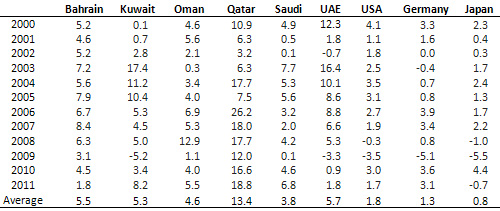
Table 1 displays the real GDP growth
rate for the six GCC members and three
industrialized countries between 2000
and 2011. Compared to the world's
three most industrialized countries,
the GCC economic growth has been very
impressive and all six GCC countries
outperformed the three industrialized
countries. In particular, Qatar's
economic growth has been phenomenal,
with double-digit average growth rate
over this period.
Table 1: Real GDP Growth Rate (%),
2000-2011
Source: Knoema.com
Given the volatility in oil prices,
the GCC countries have realized that
economic diversification is the only
feasible way forward to create long-term,
sustainable growth. They have focused
their development on industries such
as tourism and financial services.
As a result, the GCC banking industry
is gearing up for change in a region
that is accelerating its growth.
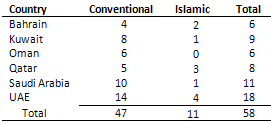
Table 2 shows the number of publicly
listed national banks for each GCC
country at the end of 2011. UAE has
the largest number of conventional
and Islamic banks. There is no Islamic
bank in Oman.
Table 2: Number of Public National
Banks by Country and Type, 2011
Source: Gulfbase.com
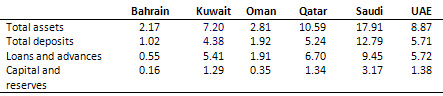
Table 3 presents four selected banking
indicators for GCC banks for 2011.
Saudi Arabian banks have the highest
average total assets, average total
deposits, average loans and advances,
and average capital and reserves,
while Bahraini banks have the lowest.
Table 3: Selected Banking Indicators
(End of 2011 average per bank, in
billions of USD)
Source: Central Bank Statistical Bulletins,
2012.
Literature Review
A large number of studies have been
conducted in measuring efficiency
and performance in the banking industry.
In the literature, two major approaches
have been taken to measure efficiency
in the banking industry: parametric
and nonparametric. Nonparametric approaches
like data envelopment analysis (DEA)
consider the whole distance from the
frontier as inefficiency. These methods
are therefore deterministic as they
do not include the possibility of
measurement errors in the estimation
of the frontier and hence they may
overestimate the inefficiencies. DEA
approach has been used by Ozkan-Gunay
& Tektas (2006) to study the efficiency
of the Turkish banking sector, by
Chang & Chiu (2006) to examine
the efficiency of Taiwan's banking
industry, and by Fitzpatrick &
McQuinn (2005) to investigate the
efficiency of UK and Irish credit
institutions, just to name a few.
Parametric approaches such as the
stochastic frontier approach (SFA)
and the distribution-free approach
(DFA) do not suffer from the above-mentioned
drawback. SFA makes some distributional
assumptions to disaggregate the residual
from the frontier into an inefficiency
term and a random disturbance, which
are arbitrary. SFA has been used by
Inui, Park, & Shin (2008) to study
the comparative efficiency of Japanese
and Korean banking and by Fitzpatrick
& McQuinn (2005) to investigate
the efficiency of UK and Irish credit
institutions. DFA has been proposed
to resolve the major criticism of
the SFA, namely its distributional
assumptions, by adopting more intuitive
assumptions to separate inefficiency
from random disturbance. DFA has been
used by Matousek, R. & Taci, A.
(2004) and by Pruteanu-Podpiera, Weill,
& Schobert (2008) to examine the
efficiency of the Czech banking industry.
Using regression, Al-Tamimi (2010)
investigated the factors affecting
the performance of UAE Islamic and
conventional national banks during
the 1996-2008 period. His results
indicate that liquidity and concentration
were the most significant determinants
of conventional banks' performance
while cost and number of branches
were the most significant determinants
of Islamic banks' performance (measured
by return on assets and return on
equity).
Ika & Abdullah (2011) compared
the financial performance of Islamic
and conventional banks before and
after the enactment of Indonesia's
Islamic Banking Act of 2008. They
found no major difference in the financial
performance between the two types
of banks, except in liquidity where
Islamic banks were generally more
liquid than conventional banks.
Fayed (2013) compared the performance
of Islamic and conventional banks
in Egypt. His findings indicate that
conventional banks dominated Islamic
banks in profitability, liquidity,
credit risk management as well as
solvency.
A number of studies have been conducted
in identifying factors affecting the
performance of Islamic and conventional
banks in Pakistan (Jaffar & Manarvi,
2011; Hanif, Tariq, Tahir, & Momeneen,
2012; Sehrish, Saleem, Yasir, Shehzad,
& Ahmed, 2012; Usman & Khan,
2012). Jaffar & Manarvi found
that Islamic banks performed better
in possessing adequate capital and
better liquidity position while conventional
banks had better performance in management
quality and earnings ability. Hanif,
et al concluded that in terms of profitability
and liquidity conventional banks led,
while in credit risk management and
solvency maintenance Islamic banks
dominated. Sehrish's findings indicate
that Islamic banks were less risky
in terms of dealing in loans and less
efficient in expense management as
compared to conventional banks. Usman
and Khan's results show that Islamic
banks had higher growth rate, profitability,
and liquidity power than conventional
banks.
Previous research were almost exclusively
single country studies that examined
either bank efficiency or performance.
This paper is the first attempt to
investigate the efficiency and performance
of conventional and Islamic national
banks in GCC countries. DFA is applied
to measure efficiency and multiple
regression analysis is used to examine
factors affecting bank performance.
Methodology
This paper has two objectives. The
first objective is to evaluate the
efficiency of the GCC banking sector
during the 2003-2011 period. A translog
cost function is estimated for all
the banks in the sample. Each bank's
efficiency is then computed as the
deviation from the most efficient
bank's intercept term. The second
objective is to determine the factors
affecting the performance of GCC conventional
and Islamic banks.
Measurement of Efficiency: the Distribution-Free
Approach
The distribution-free approach (DFA)
is used to provide evidence on the
level of banking efficiency in the
GCC. Using a fixed-effects model,
inefficiency is estimated from the
value of a bank-specific dummy variable.
The following translog cost function
is estimated for all the banks in
the sample:

The above translog cost function has
one output (loans, y) and three input
prices (labor, physical capital, and
borrowed funds). The price of labor
is measured by the ratio of personnel
expenses to total assets (w1).
The price of physical capital is defined
as the expenses for physical capital
to fixed assets (w2).
The price of borrowed funds is defined
as the ratio of interest expense to
borrowed funds (w3).
The DFA approach is applied and it
is assumed that the difference in
the actual and predicted cost for
a given cross-sectional period is
a combination of persistent inefficiency
component and a random component (Berger,
1993). It is possible to obtain the
persistent inefficiency component
by averaging out these differences
over time. Following Hunter and Timme
(1995), the error term bank i in time
t can be expressed as:
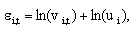
where ln(vi,t) is a random error component
that varies with time and is distributed
with a zero mean over time, and ln(ui)
is the core efficiency or average
efficiency for each bank which is
time-independent while random error
tends to average out over time. In
order to be consistent with this error
term specification, the cost function
can then be expressed with a residual
in the multiplicative form:
Costi,t = Ct(Qi,t,Pi,t)vi,t,ui,
where Ct is
a cost function and Qi,t
and Pi,t are
output and input prices, respectively.
This cost function in logarithm is:
1nCosti,t =
1nCt(Qi,t,Pi,t)
+ 1n(vi,t) +
1n(ui).
The term 1n(ui)
is assumed to be orthogonal to the
regressors in the cost function. The
error term  i,t
can be estimated for each bank for
each year. In this way the parameters
in the cost function and the random
error term 1n(vi,t)
are allowed to change for each year
while 1n(ui)
remains constant over time. i,t
can be estimated for each bank for
each year. In this way the parameters
in the cost function and the random
error term 1n(vi,t)
are allowed to change for each year
while 1n(ui)
remains constant over time.
The next step is to average the estimated
cost function, error term i,t
for each bank over n years in order
to obtain an estimate of 1n(ui),
that is 1n(ui)
= 
For each bank then the percentage
efficiency measure can be expressed
as:
EFFi = exp[1n(umin)
– 1n(ui)],
where 1n(umin)
is the minimum value of 1n(ui).
From this formulation an efficiency
value of 1 corresponds to the most
efficient bank while all other banks
have values between 1 and 0.
Factors Affecting Bank Performance
Profitability is one of the widely
used indicators to measure the performance
of any business. Financial ratios
used in this study for measuring a
bank's profitability are: return on
average assets (ROAA), return on average
equity (ROAE), and cost to income
(C/I) ratio. For ROAA and ROAE, the
higher the ratio, the better is the
bank's performance. For cost to income
ratio, the lower the ratio, the better
is the bank's performance.
Maintaining adequate liquidity is
one of the major challenges that banks
face. Liquidity ratios measure a bank's
ability to meet its short-term obligations.
In this study three liquidity ratios
are used: net loans to total assets
(NL/TA) ratio, liquid assets to customer
deposits and short-term funding (LA/DSF)
ratio, and net loans to total deposits
and borrowings (NL/TDB) ratio. The
higher the NL/TA ratio, the lower
is the bank's liquidity. The higher
the LA/DSF ratio, the more liquid
is the bank. The higher the NL/TDB
ratio, the higher is the chance that
the bank faces liquidity risk.
Solvency is the ability of a bank
to have enough assets to cover its
liabilities. A bank is insolvent if
its equity is negative. The first
ratio used to gauge solvency is equity
to total assets (E/TA) ratio. The
higher the E/TA ratio, the larger
is the bank's capacity to absorb loan
losses. The second ratio used is equity
to net loans (E/NL) ratio. The higher
the E/NL ratio, the larger is the
bank's capacity to absorb loan losses.
The third ratio used is impaired loans
to gross loans (IL/GL) ratio. The
lower the IL/GL ratio, the better
is the bank's credit quality and the
lower is its loan losses.
To examine factors affecting bank
performance, the following multiple
regression model is used:
PERF = b0 +
b1GDP + b2TA
+ b3FD + b4LIQ
+ b5CON + b6SAL
+
where
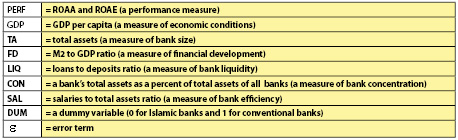
Two controlled variables are used
in the regression model. Since larger
banks might have enjoyed scale or
scope economies that had positive
effects on their performance, the
size of banks in terms of assets (scale)
is used to control for bank size.
In addition, as business cycle might
also affect bank performance, GDP
per capita is used to control for
macroeconomic conditions.
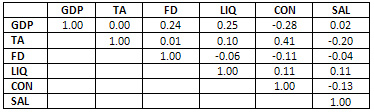
Before running the regression, a multicollinearity
test is used to examine the degree
of correlation among the explanatory
variables. Table 4 shows the pairwise
correlations. As the highest correlation
is only 0.41, the explanatory variables
are not multicollinear.
Table 4: Correlation Coefficients
of Explanatory Variables
Data
The sample consists of 58 GCC conventional
and Islamic banks listed in the respective
stock exchanges during the 2003-2011
period. All the required data are
extracted from the annual reports
of the banks and the Statistical Bulletin
of the central banks.
Empirical findings
To explore bank efficiency, the panel
data for all national banks that operated
throughout the whole study period
is used. The DFA approach is employed
to calculate the efficiency scores
of the banks. As shown in Table 5,
Masraf Al Rayan of Qatar was the most
efficient bank while Kuwait Finance
House was the least efficient bank
during the study period. It is interesting
to note that both are Islamic banks.
Table 5: Efficiency of Islamic
Banks, 2003-2011
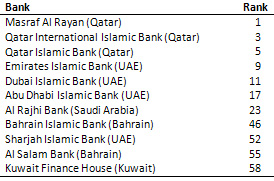
Table 6 and Figures 1-3 show the profitability
ratios of conventional and Islamic
banks between 2003 and 2011. In general,
all three ratios indicate that Islamic
banks were more profitable than conventional
banks during the 2005-2009 period.
Table 6: Profitability Ratios of Conventional
versus Islamic Banks
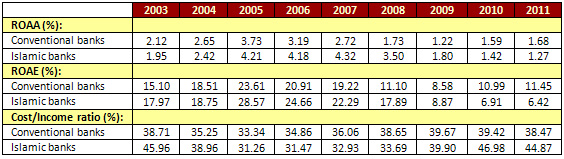
Figure 1: Return on Average Assets
(ROAA) of Conventional versus Islamic
Banks
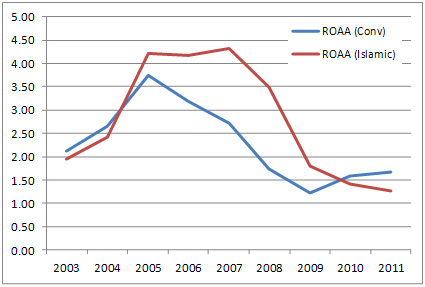
Figure 2: Return on Average Equity
(ROAE) of Conventional versus Islamic
Banks
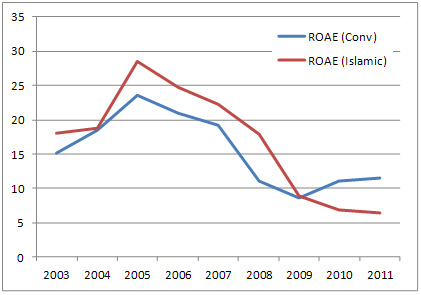
Figure 3: Cost to Income (C/I)
Ratio of Conventional versus Islamic
Banks
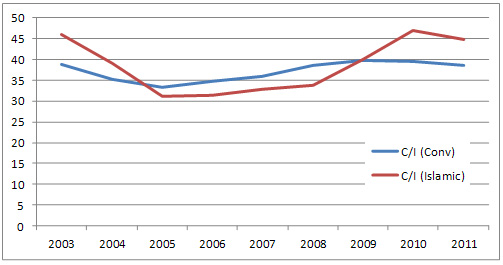
Table 7 and Figures 4-6 present the
liquidity ratios of conventional and
Islamic banks between 2003 and 2011.
In general, all three ratios reveal
that Islamic banks were more liquid
than conventional banks for the 2006-2011
period.
Table 7: Liquidity Ratios of Conventional
versus Islamic Banks
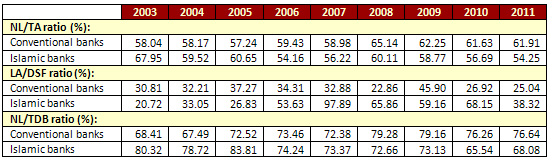
Figure 4: Net Loans to Total Assets
(NL/TA) Ratio of Conventional versus
Islamic Banks
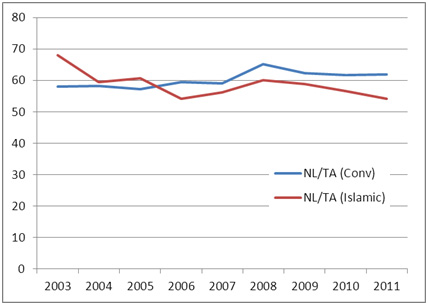
Figure 5: Liquid Assets to Deposits
and Short Term Funding (LA/DSF) Ratio
of Conventional versus Islamic Banks
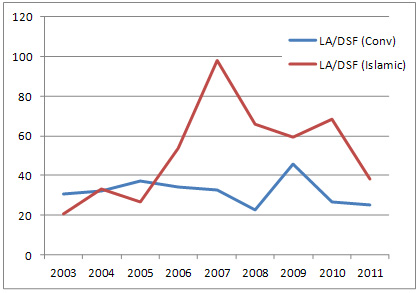
Figure 6: Net Loans to Total Deposits
Borrowings (NL/TDB) Ratio of Conventional
versus Islamic Banks
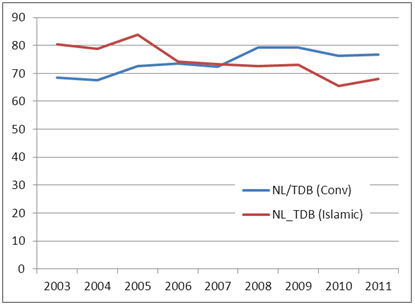
Table 8 and Figures 7-9 display the
solvency ratios of conventional and
Islamic banks between 2003 and 2011.
In general, all three ratios indicate
that Islamic banks were more solvent
than conventional banks during the
2006-2011 period.
Table 8: Solvency Ratios of Conventional
versus Islamic Banks
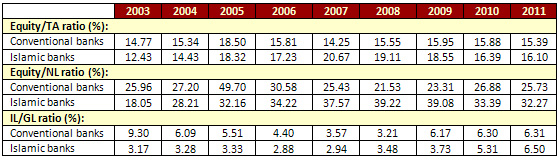
Figure 7: Equity to Total Assets
(E/TA) Ratio of Conventional versus
Islamic Banks
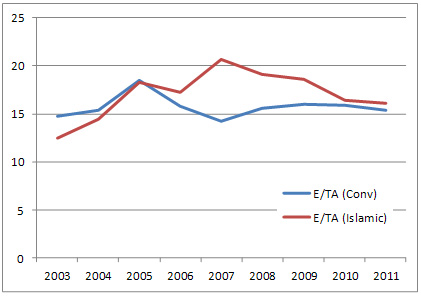
Figure 8: Impaired Loans to Gross Loans
(IL/GL) Ratio of Conventional versus
Islamic Banks
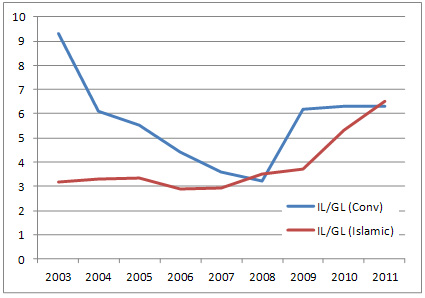
Figure 9: Equity to Net Loans Ratio
(E/NL) of Conventional versus Islamic
Banks
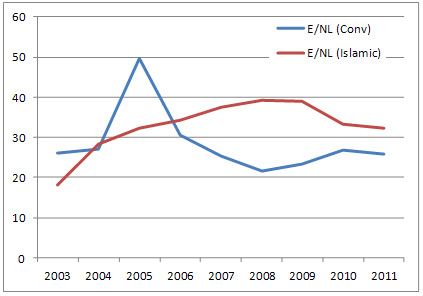
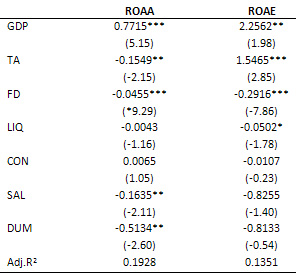
Table 9 presents the results for
the two regression models using return
on average assets (ROAA) and return
on average equity (ROAE) as the dependent
variable. The regression results are
better when ROAA is used as the dependent
variable. GDP per capita, total assets,
M2 to GDP, salaries to total assets,
and type of bank (conventional or
Islamic) are significant variables
affecting ROAA.
Table 9: Regression Results
* Significant at 10% level.
** Significant at 5% level.
*** Significant at 1% level.
Conclusion
In this study, we used a sample of
58 publicly listed GCC national banks
to examine the efficiency and performance
of the GCC banking sector between
2003 and 2011. The results indicate
that Masraf Al Rayan of Qatar was
the most efficient bank (an Islamic
bank) while Kuwait Finance House (also
an Islamic bank) was the least efficient
bank. Conventional banks were more
profitable, liquid, and solvent than
Islamic banks during the earlier years
of the study period whereas Islamic
banks were more profitable, liquid,
and solvent than conventional banks
during the later years of the study
period. Regression results indicate
that economic conditions, bank size,
financial development, operating costs,
and the type of bank (conventional
versus Islamic) are significant variables
affecting ROAA.
References
Al-Tamimi, H. 2010. Factors influencing
performance of the UAE Islamic and
conventional national bank. Global
Journal of Business Research, 4 (2):
1-9.
Berger, A. 1993. Distribution-free
estimates of efficiency in the U.S.
banking industry and tests of the
standard assumptions. Journal of Productivity
Analysis, 4: 261-292.
Chang, T., & Chiu, Y. 2006. Affecting
factors on risk-adjusted efficiency
in Taiwan's banking industry. Contemporary
Economic Policy, 24 (4): 634-648.
Fitzpatrick, T., & McQuinn , K.
2005. Cost efficiency of UK and Irish
Credit Institutions. The Economic
and Social Review, 36 (1): 45-66.
Fayed, M. 2013. Comparative performance
study of conventional and Islamic
banking in Egypt. Journal of Applied
Finance & Banking, 3 (2): 1-14.
Hanif, M., Tariq, M., Tahir, A., &
Momeneen, W. 2012. Comparative performance
study of conventional and Islamic
banking in Pakistan. International
Research Journal of Finance and Economics,
83: 62-72.
Hunter W., & Timme, S. 1995. Core
deposits and physical capital: A reexamination
of bank scale economies and efficiency
with quasi-fixed input. Journal of
Money, Credit, and Banking, 27 (1):
165-185.
Ika, S., & Abdullah, N. 2011.
A comparative study of financial performance
of Islamic banks and conventional
banks in Indonesia. International
Journal of Business and Social Science,
2 (15): 199-207.
Inui, T., Park, J., & Shin, H.
2008. International comparison of
Japanese and Korean banking efficiency.
Seoul Journal of Economics, 21( 1):
195-227.
Jaffar M., & Manarvi, I. 2011.
Performance comparison of Islamic
and conventional banks in Pakistan.
Global Journal of Management and Business
Research, 11 (1).
Matousek, P., & Taci, A. 2004.
Efficiency in banking: Empirical evidence
from the Czech Republic. Economics
of Planning, 37( 2): 225-244.
Ozkan-Gunay E. & . Tektas, A.
2006. Efficiency analysis of the Turkish
banking sector in precrisis and crisis
period: a DEA approach. Contemporary
Economic Policy, 24 (3): 418-431.
Pruteanu-Podpiera, A., Weill, L.,
& Schobert, F. 2008. Banking competition
and efficiency: A micro-data analysis
on the Czech banking industry. Comparative
Economic Studies, 50 (2): 253-273.
Sehrish, S., Saleem, F.,Yasir, M.,
Shehzad, F., & Ahmed, K. 2012.
Financial performance analysis of
Islamic banks and conventional banks
in Pakistan: A comparative study.
Interdisciplinary Journal of Contemporary
Research in Business, 4 (5): 186-200.
Usman, A., & Khan, M. 2012. Evaluating
the financial performance of Islamic
and conventional banks of Pakistan:
A comparative analysis. International
Journal of Business and Social Science,
3 (7), 253-257.
Wu, H., Chen, C., & Shiu, F. 2007.
The impact of financial development
and bank characteristics on the operational
performance of commercial banks in
the Chinese transitional economy.
Journal of Economic Studies, 34 (5):
401-414.
|